One and the Same: The Design Partner Problem and the GTM Problem
For years, tech startups have followed a well-trod path to launch.
- Ideation: identify a serious business problem and therefore opportunity that can be addressed through a software App , automated service or platform.
- Validation: In consultation with product design partners—individuals with deep experience with a startup's business premise—gather informed guidance on whether the premise is workable, and if a proposed solution will in fact address an existing pain point. And perhaps most importantly, is this proposed offering valuable enough that a user will pay for it and ideally can’t live without.
- Development: The engineering and building stage where a Minimum Viable Product (MVP) tests core features with real users before further iteration and production at scale.
- Go To Market (GTM): The MVP is launched as a commercial offering backed by a scalable marketing and sales plan to drive brand awareness and demand via nurture campaigns, etc.
The conventional approach treated validation, development and GTM as sequential stages: prove the idea works, build it, then go sell it. As with so many established ways of doing business in the AI era, this neat formulation has now been fundamentally upended, if not rendered obsolete.
The hardest part isn't the idea or the development.
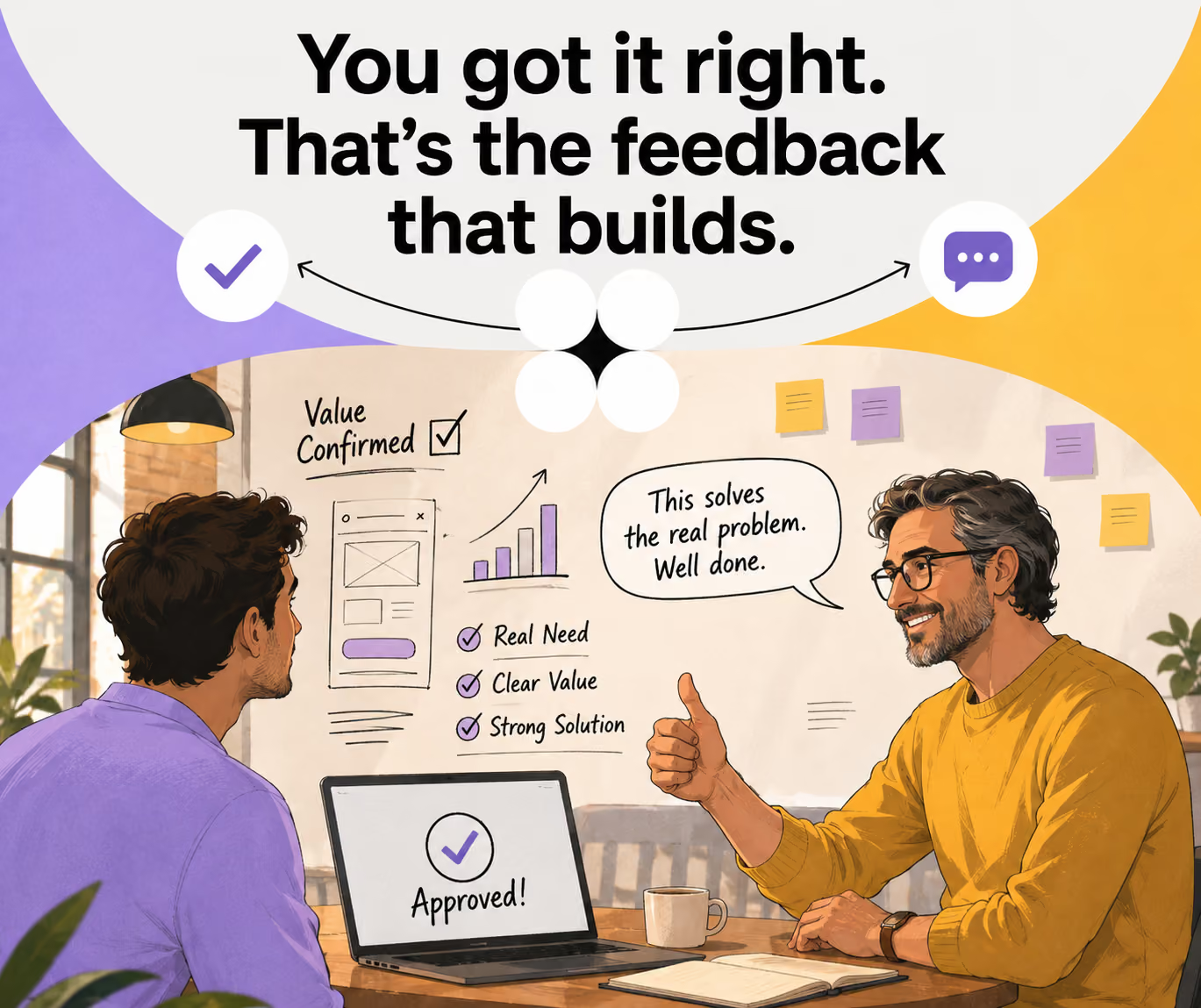
It's finding users who tell you if you got it right.
Today, every early-stage startup faces the same quiet crisis: finding design partners—people with deep, real experience in the problem space—who can tell you honestly whether your business premise is valid and worthwhile. Experts who can confirm whether what you're building actually solves a pain that exists in the world, not just on a whiteboard.
In years past, the development stage was the hardest part. Coding was the difficult and time-consuming process. Getting to an MVP used to take months. As such, validation and building could, and often would, proceed roughly in parallel. Today, building isn't the bottleneck. With AI (Claude Code), most founders can ship an MVP in days. The new risk is that teams are moving so fast that they don’t have the time to engage, or even find, experts with the comprehensive domain experience required to validate it before it's "done." Well it’s never done-done but at least to a working solution that solves that defined pain or need.
This is certainly how it’s been playing out for the AI-first founders in super{set}'s orbit. Consider a hypothetical startup building a payments platform for agentic processes. The founders need feedback from multiple distinct groups: people who understand AI, the financial industry, users in governance, and the regulatory environment — all at a genuinely deep level, not a surface-level familiarity with component parts. That's the catch. Most founders lean on their own professional networks to find expert design partners, but very few networks span all functional disciplines at once. This is not a hustle problem. It's a structural one: the expertise a startup needs to validate itself rarely lives in one person, and rarely lives in a founder's contact list.
Which turns out to be the same problem as finding your first customers.
Here's where this dynamic gets interesting. Startups face an almost identical challenge finding early customers. And, increasingly, founders are realizing it's not almost identical, it's the same search. In an ideal world, a solid chunk of your design partners should become paying customers over time. The person qualified to tell you whether your solution is real is very often the same person who'd buy it, assuming relevancy and value.
Across the super{set} portfolio, this realization is showing up as a behavior change: founders aren't waiting for a validated product before they start seeking their ideal customer profile (ICP). As soon as there's an MVP, founders start reaching out to people who fit both the design-partner profile and the customer profile simultaneously. Several portfolio companies have gone further and embraced a GTM-first approach from the get-go. In some cases founders learn, quickly and disagreeably, that their MVP wasn't viable at all once it was put in front of a group of people who genuinely understood the space in all of its nuanced complexity. That’s actually a good thing. By learning this early, you avoid wasting time and resources.
Where AI helps. And where it can't.
Naturally, the question follows: can AI shortcut any of this? Specifically, can synthetic data or AI-generated interviews stand in for the design partner conversations if a founder can't easily get? The honest answer is more nuanced than yes or no. Synthetic and AI-generated user research is genuinely useful for compressing a chunk of validation work. This would include screening out weak concepts, sharpening hypotheses, stress-testing messaging, figuring out which questions are even worth bringing to a real human. However, you lack true competitive advantage because another founder is finding the same answers you are.
What AI isn't trusted for, by the people actually using these tools, is anything that touches the decisions that matter most: real product-market fit, pricing, demand forecasting and direct feedback on someone seeing your MVP for the first time. Anywhere there's capital on the line, human intelligence is indispensable. One research-industry survey found only about 8% of research professionals use synthetic-user tools regularly, even though 97% use AI somewhere in their workflow. That gap is the story.
This is not to say that synthetic personas – AI-generated profiles built from real behavioral data and LLMs to simulate audience reactions – don’t have a place in start-up product design. They can be quite valuable in testing product concepts and messaging against likely customer respondents. Yet founders need to keep in mind that synthetic research tends to converge on the most probable, generic response rather than capturing the range of real human behavior; they skew agreeable, emotionally flat, and Western in perspective, exactly the qualities you don't want when you're trying to find out if you're wrong.
Still, these are not necessarily disappointing findings. It’s intelligence that can give founders a clean, defensible framework instead of a hype cycle: synthetic personas as a pre-filter, real design partners as the actual gate. AI doesn't replace the design-partner search; it changes what you ask them once you finally get the meeting. A good analogy to keep in mind is that synthetic research has a lot in common with weather forecasting. A three-day forecast is going to be a lot more reliable than a 10-day forecast.
There's also a second, more defensible way AI earns its keep here. Not by simulating experts, but finding real ones. Now it becomes a process of mapping a founder's extended network to surface people who actually hold the intersectional expertise a given thesis needs. Smart founders are mining second- and third-degree LinkedIn connections, podcast guest lists, conference speaker rosters, patent filings, regulatory comment submissions, then building a warm-intro path to the most promising experts. Here is where AI can shine as a research and matching tool, working in service of human judgment rather than standing in for it. This then quickly translates to a more engineered and well thought out approach once you identify the key criteria of your ICP. In GTM speak, this is the intent signals that are coveted as early as possible to identify the best-fit partners, i.e. future customers.
The discovery problem isn't the whole problem.
Solving who to find still leaves the harder question open: what happens when a startup skips this step — when speed to market wins out over getting the right person in the room before shipping? That's a more dramatic story, and a more uncomfortable one for AI-native founders who've been told building fast is the whole game. It's also exactly where we're headed next.
Tech, startups & the big picture
Subscribe for sharp takes on innovation, markets, and the forces shaping our future.
Let's keep in touch
We're heads down building & growing. Learn what's new and our latest updates.