New Engines, New Rules. Do You Have a Playbook for Navigating the New AEO/GEO Environment?
New Engines, New Rules. Do You Have a Playbook for Navigating the New AEO/GEO Environment?
AI has reordered many basic functions and qualities of the Internet over the past 12 to 18 months. Yes, AI has fundamentally transformed search from a directory of links into a conversational assistant. But it’s more than that. In 2025 organic traffic decreased by 15-25%, and with traditional search engines, about 60% of searches now end without the user progressing to another destination. A huge chunk of B2B buyers, 69%, choose a different vendor based on AI chats.. AI bot traffic saw a 3X increase over the past 18 months.
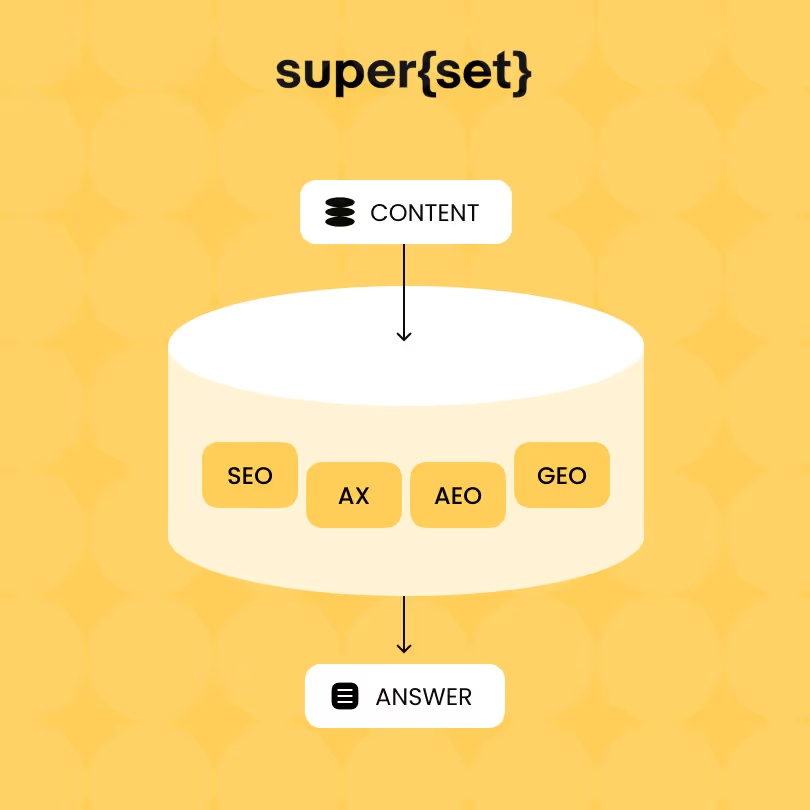
It’s in this context that the tenets of Answer Engine Optimization (AEO) aka Generative Engine Optimization, are now coming into clear focus. In many ways, AEO is an extension of SEO best practices. Methods like content optimization and link building remain effective techniques for upping online brand awareness and driving traffic. Where AEO is evolving in new directions, however, is with what was conventionally known as technical SEO.
Many technical aspects of AEO will look familiar to experienced SEO practitioners. Search engine indexing verification through Google Search Console and Bing Webmaster Tools is still important. Likewise, submitting new content URLs to the IndexNow system will immediately get content in front of Google, Bing, and DuckDuckGo — no need to wait weeks for these engines to crawl it.
Where Do the Qualities of SEO and AEO Diverge?
Where AI search diverges from conventional SEO is with schema. Schema for AEO is structured data code (usually in JSON-LD format) added to your website's HTML. It utilizes standardized vocabulary from Schema.org to explicitly label the meaning of your content, helping Large Language Models (LLMs) and AI search engines easily parse, trust, and cite your information. For websites without optimized schema, AI systems must infer context from language patterns and text layout, which can lead to misquotes or hallucinated information. Schema eliminates this ambiguity by explicitly declaring what your content is, who wrote it, and how it connects to real-world facts
AI answer engines like Perplexity or ChatGPT Search may share crawling infrastructure with conventional search, but their purpose is sharply different. Where conventional engines rely on keyword matching, metadata, and link analysis to gauge relevance and authority, AI engines use transformer-based models to reason across full texts — synthesizing and returning answers rather than simply returning ranked pages.
The practical downstream difference is notable. Conventional SEO rewards structure, authority signals, and keyword targeting. AI answer engines tend to reward clarity and directness (answers stated plainly, not buried in preamble), factual density (well-sourced, specific information), logical structure (content that can be chunked and understood out of context), and trustworthiness signals such as author credentials, citations, and E-E-A-T (experience, expertise, authoritativeness, and trustworthiness).
Technical AEO — What Do AI Crawlers Actually See?
Most modern websites are heavily JavaScript-dependent. Single-page application frameworks, tag management systems, dynamic content loaders — all of this is invisible to AI crawlers that don't execute JavaScript. What they see is the raw HTML delivered at page load. If your core value proposition, product descriptions, or schema markup are being injected by JavaScript after initial render, those elements effectively don't exist from an AI discovery standpoint.
Several technical practices are specifically relevant to AEO performance:
Schema markup is more important than ever. Structured data — particularly FAQ, HowTo, and Article schema — gives AI systems explicit, machine-readable context about your content. The goal is to make your content's structure unambiguous, not just for Google's parsers but for any LLM crawling your domain.
The llms.txt convention is gaining traction. Functioning analogously to robots.txt, an llms.txt file provides AI-specific guidance on which content an LLM should prioritize when indexing your site. Combined with a detailed sitemap.xml, these files create a solid roadmap for shaping how engines crawl, understand, and reflect your content — to both human and agentic audiences.
Server-side rendering is an AEO advantage. Server-side rendering (SSR) or static site generation (SSG) ensures fully-formed HTML is delivered on the first request, meaning AI crawlers see the same content a browser would render after JavaScript execution. For sites built on modern frameworks, this is often configurable without a complete rebuild.
"AX" — AI Agent Experience — is an emerging framing worth adopting. Just as UX asks "how does a human navigate this?", AX asks "how does an AI agent parse and use this?" A page optimized for AX is one where an AI can extract a reliable, accurate summary in seconds — achieved through clear heading hierarchy, key claims placed near the top, and unambiguous entity definitions.
AEO best practices aren’t all about technical aspects of website management. Simply reframing section headings in your pages and blogs as questions can drive approximately a 13% increase in AI traffic. And keeping your content fresh can matter a lot: 95% of ChatGPT citations were from content posted within the past 10 months. The good news is that AEO visits convert better than conventional search traffic – by approximately 14%.
AEO isn't a replacement for SEO — it's an evolution that demands new technical rigor. As AI engines increasingly mediate the relationship between brands and buyers, the sites that win will be the ones built for both human readers and AI agents: clean server-rendered HTML, explicit schema, clear answers up front, and content fresh enough to earn citation. The playbook is still being written, but the businesses that start adapting now will have a decisive head start over those waiting for AEO to become conventional wisdom.
Tech, startups & the big picture
Subscribe for sharp takes on innovation, markets, and the forces shaping our future.
Let's keep in touch
We're heads down building & growing. Learn what's new and our latest updates.